
Sub-Zero sealed system & compressor repair in Cupertino
The most expensive repair category deserves the most proof. We only name the sealed system after pressures and electrical readings back it up — never on a guess.
A true Sub-Zero sealed-system fault means a refrigerant leak, a restriction, or a worn compressor — not a fan or a board. Because it is the costliest repair, we confirm it with manifold pressures, electrical readings and temperature behavior before we quote a dollar. Many units sent out for a "compressor" really need a $300 part. Diagnosis runs an $89 service call that is waived when you book the repair, and every sealed-system job carries a 365-day labor warranty.
925 reviews · 4.9 / 5
What the sealed system actually is
Every built-in Sub-Zero cools through a closed loop of components working in sequence. When one part of that loop fails or leaks, the whole circuit loses its ability to move heat — and the symptom at the door can look identical to a simple fan or airflow fault.
- Compressor. The pump that circulates refrigerant under pressure. A worn or seized compressor can run hot, draw high current, or fail to build pressure at all.
- Condenser. Sheds heat from the high-pressure refrigerant. On dusty Cupertino remodels a blanketed condenser mimics a sealed-system failure without being one.
- Evaporator. Absorbs heat inside the cabinet. A leak here is a true sealed-system repair; frost here is usually a defrost or airflow issue instead.
- Filter-drier and capillary / metering. A restriction or moisture in the drier starves the evaporator and is one of the most misdiagnosed faults in the loop.
- Refrigerant charge. A slow leak drops capacity gradually, so the unit runs longer and longer before it stops cooling entirely.
The honest takeaway: a warm built-in is far more often a fan, damper, defrost or condenser problem than a sealed-system one. The diagnosis exists to tell those apart with evidence, not to default to the most expensive answer. If your unit is simply running warm, start at Sub-Zero not cooling first.
Pressure and electrical proof before a single dollar is quoted
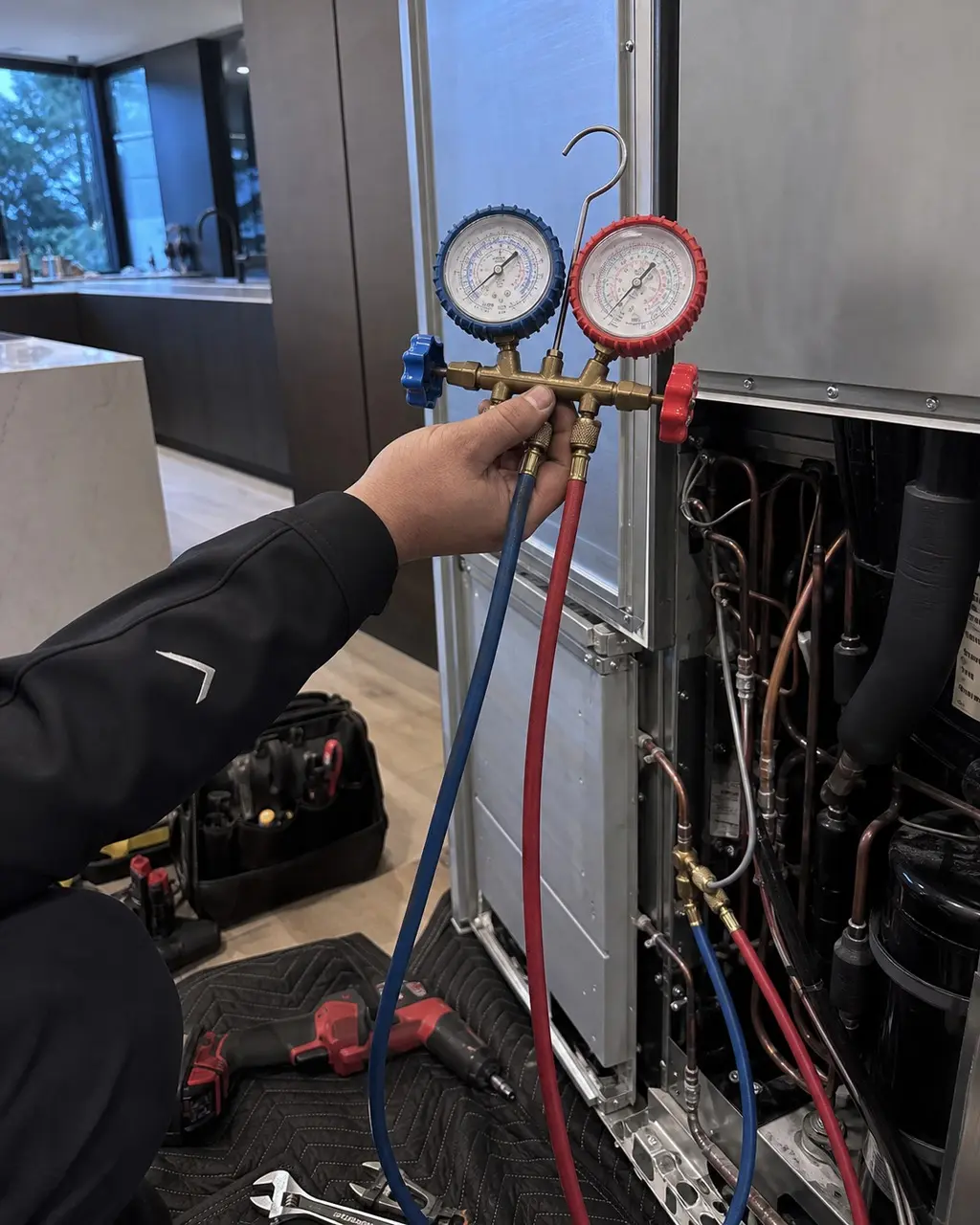
Sealed-system work is the one repair where guessing is genuinely expensive, so we treat the quote as something that has to be earned. Before we ever say "compressor" or "leak," we attach manifold gauges, read high and low side pressures, and check the compressor's electrical draw and start behavior against factory-spec values.
- Pressure test. Gauges show whether the charge is correct, low from a leak, or pinned by a restriction.
- Electrical proof. Current draw, windings and start components reveal a tired or seized compressor versus a healthy one.
- Temperature mapping. Where the cold stops along the evaporator points to a leak, a partial restriction, or a charge problem.
- Leak confirmation. We locate and verify the leak before any repair so the fix actually holds.
Signs it is — and is not — the sealed system
Most warm built-ins fall in the right column. The sealed system is confirmed on site, never assumed.
| What you observe | Probably the sealed system | Probably NOT — cheaper fix |
|---|---|---|
| Compressor runs constantly, cabinet slowly warms | Low charge from a refrigerant leak | Dirty condenser or worn door gasket |
| Cold stops partway along the evaporator | Restriction in the drier or metering device | Frost-blocked coil from a defrost fault |
| Compressor hums, clicks, then shuts off | Seized compressor or failed start winding | Failed start relay or control board |
| Fridge warm, freezer still frozen | Rarely the sealed system | Failed circulation fan or stuck damper |
| Unit dead quiet, no compressor at all | Open compressor winding (less common) | Tripped breaker, bad relay, or board |
Patterns are typical for built-in Sub-Zero units; your exact fault is verified with pressures and electrical readings before any quote.
How to tell before you call
A few safe observations help separate a sealed-system fault from a cheaper one — and none of them require opening the circuit.
- 01
Clear and recheck the condenser
Open the upper grille and clear any dust from the condenser. A blanketed condenser causes long run times that imitate a sealed-system fault.
- 02
Listen to the compressor
Note whether it runs steadily, never starts, or hums and clicks off. That start behavior is a strong early clue for the technician.
- 03
Feel where the cold stops
If one zone is fine and another never cools, the issue is more likely airflow or a fan than the refrigerant loop itself.
- 04
Watch the run pattern
A unit that runs nonstop yet drifts warmer over days suggests a slow charge loss worth confirming with gauges.
- 05
Have the model number ready
Find your model and serial so we match compressor and drier specs before arrival. Use the model lookup if you are unsure.
Repair or replace an older integrated unit
When a genuine sealed-system fault lands on an older 500- or 600-series built-in, the decision is rarely automatic. A panel-ready Sub-Zero is engineered to be rebuilt, and the cabinetry around it in a Cupertino kitchen is often worth more than the appliance itself — so a sound repair frequently beats tearing out custom millwork for a new integrated unit.
We give you the math plainly: the proven fault, the genuine OEM Sub-Zero parts involved, and an honest read on the rest of the circuit's condition. If the compressor and evaporator are strong and the problem is a leak or restriction, repair usually wins. If multiple sealed-system components are failing at once on a very old unit, we will tell you that too. For full ranges, see repair pricing, or compare against full built-in refrigerator service.
What sealed-system & compressor repair typically costs
Sealed-system work sits at the top of the range — which is exactly why it is only quoted after pressure and electrical proof. The $89 diagnostic is waived when you book the repair.
| Service | Range | Time | Notes |
|---|---|---|---|
| Diagnostic / service call | $89 | 45–90 min | Waived when you book the repair — model, temps, airflow, fascia/panel check |
| Door gasket / frost-line | $400–$950 | 1–3 h | Depends on model and gasket availability |
| Ice maker / water line | $290–$880 | 1–3 h | Valve, fill tube or ice module |
| Panel-ready pull-out & reseat | $250–$600 | 1–2 h | Cabinet-safe extraction, no fascia damage |
| Control board / sensor | $360–$1,300 | 1–4 h | Quote after electrical proof |
| Compressor / sealed system | $1,500–$3,800 | 2–6 h + parts | Requires pressure / electrical evidence |
Draft ranges for planning; final quote depends on model, parts, cabinet access and diagnosis.
Quick answers on sealed-system repair
Fast clarity on the questions Cupertino owners ask most before booking.
Is the compressor really the problem?
Usually not. Many units quoted for a "compressor" actually need a fan, relay or board. We confirm a true compressor fault with electrical readings and pressures before naming it.
Can a refrigerant leak be fixed?
Yes, when we locate and verify it. We repair the leak, evacuate the circuit, recharge to spec and prove it holds — never a quick top-up that fails again in weeks.
How long does a sealed-system repair take?
Plan on a longer visit — recovery, evacuation, charging and verification take time, and some jobs need parts ordered. We give a realistic window with the quote.
Should I keep running it meanwhile?
No. Running a failing compressor or leaking circuit can enlarge the repair. Power it down, move perishables, and book a diagnosis.
What Cupertino homeowners say
Another shop quoted a full compressor on our 600-series built-in. These folks put gauges on it, proved the compressor was fine, and traced a restriction in the drier instead. Repaired for a fraction of the quote, with the $89 call credited. Genuinely honest work.
Our integrated unit was running nonstop and slowly losing temperature. They found a refrigerant leak at the evaporator, fixed and recharged it properly, and verified it held before leaving. No guesswork, clear written quote, and the 365-day warranty gave us peace of mind.
Compressor would hum and click off on our panel-ready column. They confirmed a failed start winding with electrical readings, sourced the genuine OEM compressor, and pulled the unit without touching the surrounding cabinetry. Careful, methodical, and worth every dollar.
Frequently asked questions
How do you know it is the sealed system and not the compressor or a fan?
We prove it before we quote it. Manifold gauges read high and low side pressures, electrical readings show the compressor's draw and start behavior, and temperature mapping tells us where the cold stops. A leak, restriction and worn compressor each leave a different signature — and many units sent out for a sealed-system job actually need a fan or board, which we would rather find for you.
What does a Sub-Zero compressor or sealed-system repair cost in Cupertino?
Sealed-system work is the highest repair category because it involves recovery, evacuation, a measured charge and verification, plus genuine OEM parts. We never quote it on a guess — the $89 diagnostic confirms the exact fault first and is waived when you book the repair. You get a written quote before any work, and every sealed-system job carries a 365-day labor warranty.
Can you just add refrigerant to my Sub-Zero?
Not as a real fix. Refrigerant only drops when there is a leak, so topping it up without finding the leak fails again quickly and can damage the circuit. We locate and repair the leak, evacuate moisture, then recharge to factory spec and verify it holds — manufacturer-recommended procedures done with factory-grade tools.
Is it worth repairing the sealed system on an older built-in?
Often, yes. Panel-ready Sub-Zero units are built to be rebuilt, and the custom cabinetry around them in a Cupertino kitchen frequently costs more than the appliance. If the compressor and evaporator are sound and the fault is a leak or restriction, repair usually beats replacement. We give you the honest condition of the whole circuit so the choice is clear.
What causes a restriction in the sealed system?
A restriction usually forms in the filter-drier or metering device from moisture or debris in the circuit. It starves the evaporator so the unit runs constantly yet never cools fully — a pattern easily mistaken for a low charge or a tired compressor. Gauges and temperature mapping separate the two, which is why we never assume.
Do you use genuine Sub-Zero parts for compressor work?
Yes. We install factory-certified, genuine OEM Sub-Zero parts for compressors, driers and circuit components, and the work follows Sub-Zero service specifications. Using the correct compressor and metering parts is what keeps a rebuilt sealed system reliable, which is why the 365-day labor warranty stands behind it.
Related Sub-Zero help

Suspect the sealed system? Get proof, not a guess.
Talk to an experienced Sub-Zero repair specialist now. We confirm compressor and refrigerant faults with pressure and electrical evidence across Cupertino and the South Bay.
925 reviews · 4.9 / 5$89 service call, waived when you book the repair · 365-day warranty on all labor.