
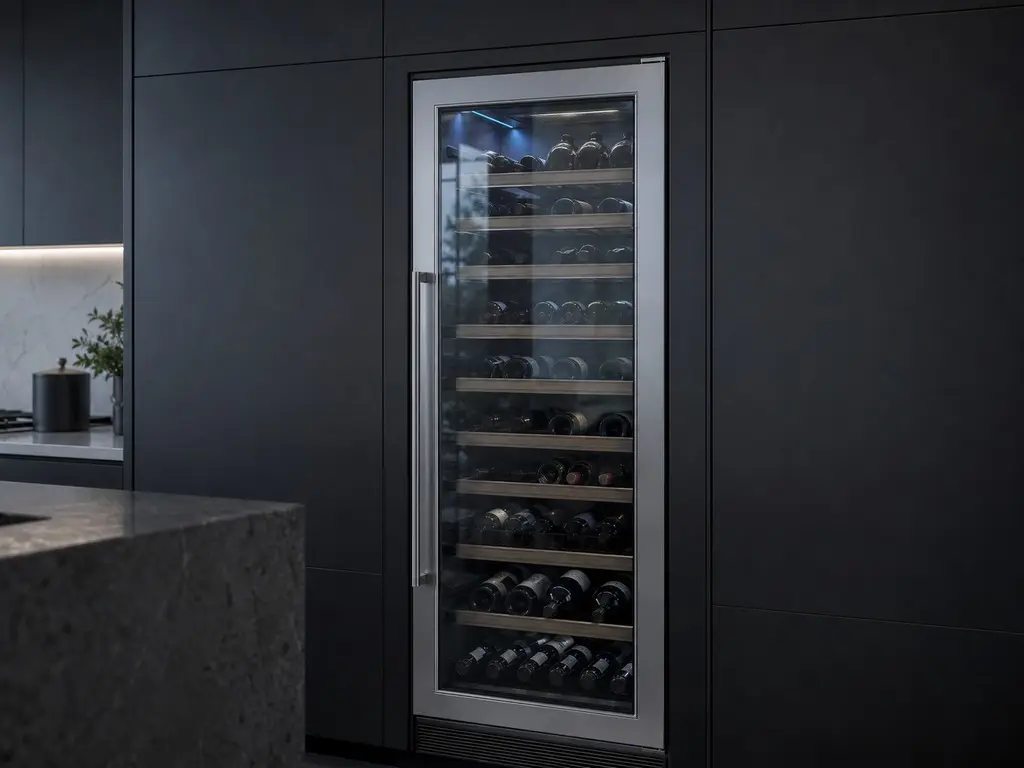
Sub-Zero builds serious wine storage — the integrated wine columns and dual-zone preservation units that turn a corner of a Monta Vista or Garden Gate kitchen into a proper cellar. They are not beverage fridges; they hold reds and whites at two separate, stable temperatures and shield the bottles from the light and vibration that age wine badly.
Which is exactly why a degree or two of drift is the call we get. A collector near Apple Park does not wait for a wine column to fail outright. They notice the lower zone reading a couple of degrees high, an alarm that chirped overnight, or condensation on the UV glass — and they want it sorted before a Santa Clara Valley heat spell turns a slow drift into spoiled bottles.
Two zones, two failure points
A dual-zone column runs one cooling system and splits it with a damper and a dedicated sensor for each compartment, so the upper zone can hold whites near serving temperature while the lower zone keeps reds in the mid-fifties. When one zone drifts and the other stays perfect, the fault is almost always local to that split — a thermistor reading a few degrees off, a damper that no longer modulates cleanly, or the small zone fan that mixes the air.
This is the most misread Sub-Zero wine symptom we see. Owners assume the whole sealed system is dying when in truth the compressor is fine and only one zone's control has wandered. A calibrated sensor swap or a damper repair restores the split without touching refrigeration at all.
Cupertino heat, a loaded condenser, and the slow climb
When both zones climb together, look at airflow before anything else. A built-in wine column sheds its heat through a front grille, and in tight Cupertino cabinet runs that grille pulls in dust, pet hair and the fine grit that settles in a valley summer. As the condenser loads up, the unit cools fine on a mild morning and then drifts warm through a hot Stevens Creek afternoon — the textbook sign of a coil that can no longer dump heat fast enough.
A clean condenser and a clear grille fix a surprising number of these calls outright. If the column still cannot hold temperature with airflow restored, the next suspects are the evaporator fan and the sealed system, which we test with gauges and electrical proof rather than guessing.
The seal, the glass and the bottles themselves
Wine columns guard against three things a regular fridge ignores: light, humidity loss and vibration. The door carries UV-tinted glass and a perimeter gasket that has to seal tight to hold the cabinet's humidity and keep warm kitchen air out. A gasket that has gone stiff at one corner lets the lower zone creep and the compressor run long — the same alignment story a panel-ready door tells, just with stakes that include a case of aging Cabernet.
Vibration matters too. A worn compressor mount or a fan bearing starting to chatter sends a low buzz through the rack that, over months, disturbs sediment and tires the wine. We check the gasket seal, the glass and the running noise on every wine call, because on a built-in cellar those quiet faults cost more than the part ever will.
Repair or replace a built-in wine column
Because a Sub-Zero wine column is integrated into the cabinetry and priced like one, replacement is rarely the first answer. A drifting zone, an alarming sensor, a loaded condenser or a failed door gasket are all bounded, OEM-parts repairs on a unit that otherwise has years of service left. We diagnose by model and serial first — temps in each zone, airflow, seal and sealed-system pressures — so you only replace the cellar if the sealed system is genuinely beyond economic repair, which on a well-kept column is uncommon.
