
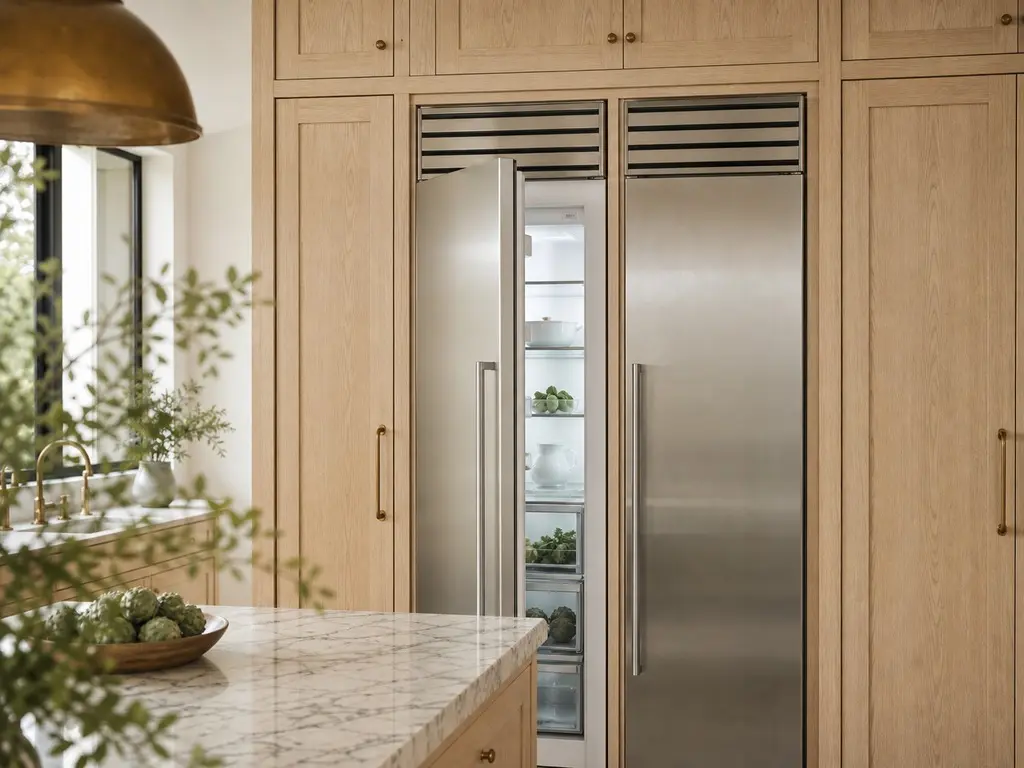
It is the question every owner of an aging built-in eventually asks: is this thing worth fixing, or am I throwing good money after bad? With a countertop microwave the answer is easy. With an integrated, panel-ready Sub-Zero in a Cupertino kitchen, the math is genuinely different — and it tilts toward repair far more often than people expect.
The reason is not loyalty to the brand. It is what replacement actually costs once you account for the cabinetry, the panel and the stone the unit is built into. This guide lays out that math honestly, by failure type and by age, so you can make the call with real numbers instead of fear.
Replacement is not just the price of the appliance
A freestanding fridge is a clean swap: wheel the old one out, wheel the new one in. An integrated Sub-Zero column is the opposite. It was sized, shimmed and trimmed into a custom cabinet run, wearing a matched wood or laminate panel, often flanked by stone and a waterfall edge. Replacing it almost never ends at the appliance price.
In a typical Apple-Park-area remodel, swapping an integrated column means re-fitting the surrounding cabinetry to the new unit's dimensions, fabricating or refinishing a custom panel to match, and sometimes adjusting the stone or the trim where tolerances changed between model years. The carpentry and the panel work can rival the cost of the appliance itself. That hidden second half of the bill is why a repair that would feel marginal on a freestanding fridge is often the obvious choice on a built-in.
Repair or replace, by what actually failed
The smartest way to decide is by the failure type, because not all repairs carry the same weight.
Fans, dampers, sensors, control boards, gaskets and ice-maker parts are bounded, OEM-parts repairs. On a unit that is otherwise sound, these are almost always worth fixing — they are a small fraction of replacement and they restore the unit to full service. There is rarely a good argument for replacing an entire integrated column over a failed evaporator fan.
The sealed system — the compressor, the refrigerant circuit, a deep leak or a restriction — is the one category where the conversation gets real. Sealed-system work is the most expensive repair, and on a much older unit it is fair to weigh it against replacement. Even then, the cabinetry cost usually keeps repair ahead unless the unit has other problems stacking up. We never call something a sealed-system failure without proving it with pressure and electrical evidence first, precisely because that diagnosis is the one that drives the biggest decision.
Cosmetic and access issues — a drifted panel, a worn gasket, a unit that needs a cabinet-safe reseat — are never replacement territory. They are exactly the kind of work that keeps a beautiful integrated kitchen looking and sealing the way it was designed to.
Age, and the 500 and 600 series question
Age matters, but not the way people assume. Sub-Zero built-ins are engineered for a long service life, and a well-kept unit can run for decades. The older 500 and 600 series columns common in established Cupertino homes are frequently worth keeping: parts are still available, the cabinetry around them is irreplaceable without a remodel, and many of their failures are the same bounded fan, gasket and board repairs that any unit needs.
The honest line is about how the failures are stacking. A fifteen-year-old unit with a single failed fan is an easy repair. The same unit on its third significant failure in two years, now facing sealed-system work, is where replacement earns a serious look. We diagnose by model and serial first — see the model and serial lookup — so the decision rests on the specific unit in front of us, not a blanket rule about age.
When we will actually tell you to replace
An independent specialist that only ever recommends repair is not being honest either. There are cases where replacement is the right call, and we will say so. A sealed-system failure on a very old unit that also has a tired compressor, worn fans and a failing board is throwing money at a unit near the end of its life. A column that has suffered real physical damage to the cabinet or the refrigeration deck may be beyond economic repair. And occasionally parts for a much older or rare unit simply are not available, which forces the question.
What we will not do is steer you toward a replacement to avoid a repair, or quote a sealed-system job we have not proven. The $89 diagnostic exists to give you the real picture — what failed, what it costs to fix, and how that compares to the all-in cost of replacing an integrated unit in your kitchen. For planning ranges by symptom, see repair pricing; to talk it through for your specific unit, call (650) 668-5618 or book online.
