
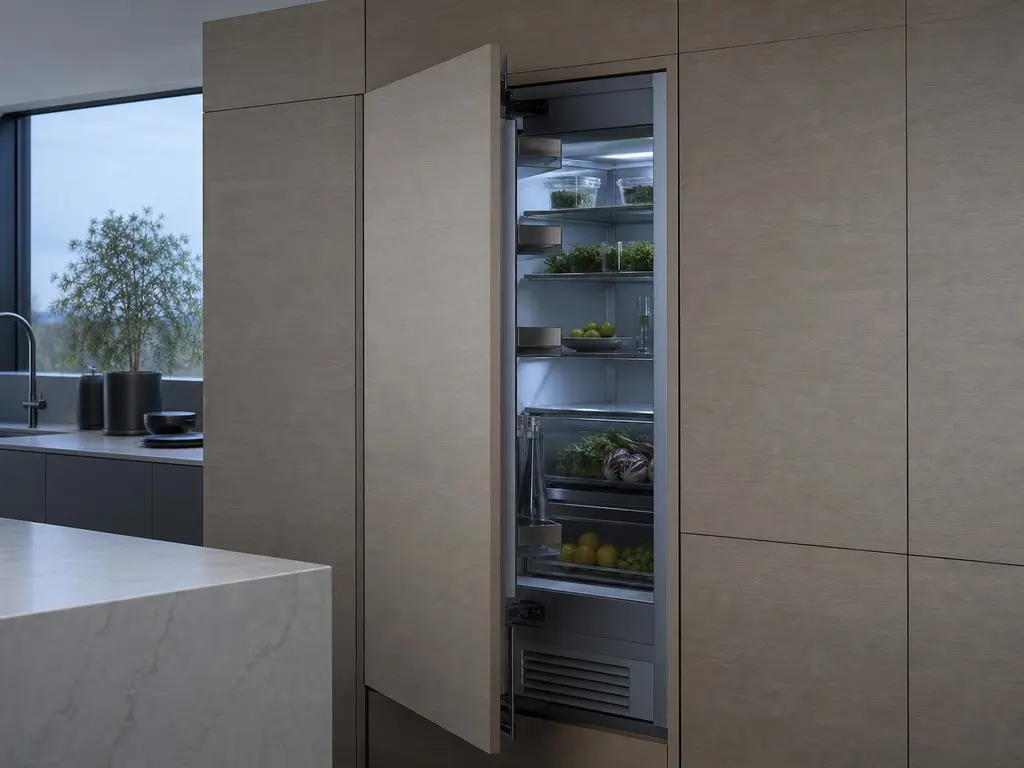
Walk through a remodeled kitchen in Monta Vista, Garden Gate or the streets around Apple Park and you will see the same thing again and again: a 36-inch or 42-inch Sub-Zero built-in wearing a custom panel that matches the cabinetry exactly, sitting flush with no visible appliance at all. It is the look the whole South Bay remodel market is built around.
That integration is beautiful, and it is also the reason a panel-ready unit needs a different kind of service than a freestanding fridge. The fascia, the panel weight and the tight install all change what fails first and how it has to be fixed.
The custom panel changes the door, not just the look
A panel-ready door carries a heavy wood or matched-laminate front that the hinges and closer were shimmed for at install. Over years of daily use that extra mass tugs the door slightly out of alignment, and the first symptom an owner notices is a gasket that no longer seals cleanly along the bottom corner. Once the seal breaks, the cabinet runs warmer and the compressor works harder to compensate.
The fix is rarely the dramatic part you might fear. More often it is a hinge cartridge, a closer adjustment, or a fresh gasket — but it has to be done with the custom panel removed and re-hung dead flush, because a panel that sits even a few millimeters proud ruins the integrated look the kitchen was designed for.
Tight cabinet runs trap heat at the top
Cupertino remodels love full-height runs with cabinetry hard up against the column on both sides and a tall cabinet bridging the top. That looks seamless, but a built-in sheds its condenser heat through the upper grille, and a too-tight top cabinet can starve that airflow. A unit that cools fine in winter but drifts warm during a hot Santa Clara Valley afternoon is often telling you the grille area is choked with dust or the clearance is marginal.
Clearing the condenser and confirming the grille can actually breathe is one of the highest-value things you can do on an integrated unit. It is also why we check airflow and the upper grille on every built-in call before we reach for a parts catalog.
Cabinet-safe extraction is half the job
Pulling a panel-ready column for a sealed-system or evaporator repair means sliding a heavy unit out past finished end panels, stone countertops and sometimes a waterfall edge — with no room for error. We protect the floor and the cabinet faces, disconnect the water line cleanly, and walk the unit out without a scuff, then reset it on its original shims so the fascia lands flush again. On a remodel that cost what these kitchens cost, that careful extraction is not a nicety; it is the point.
