
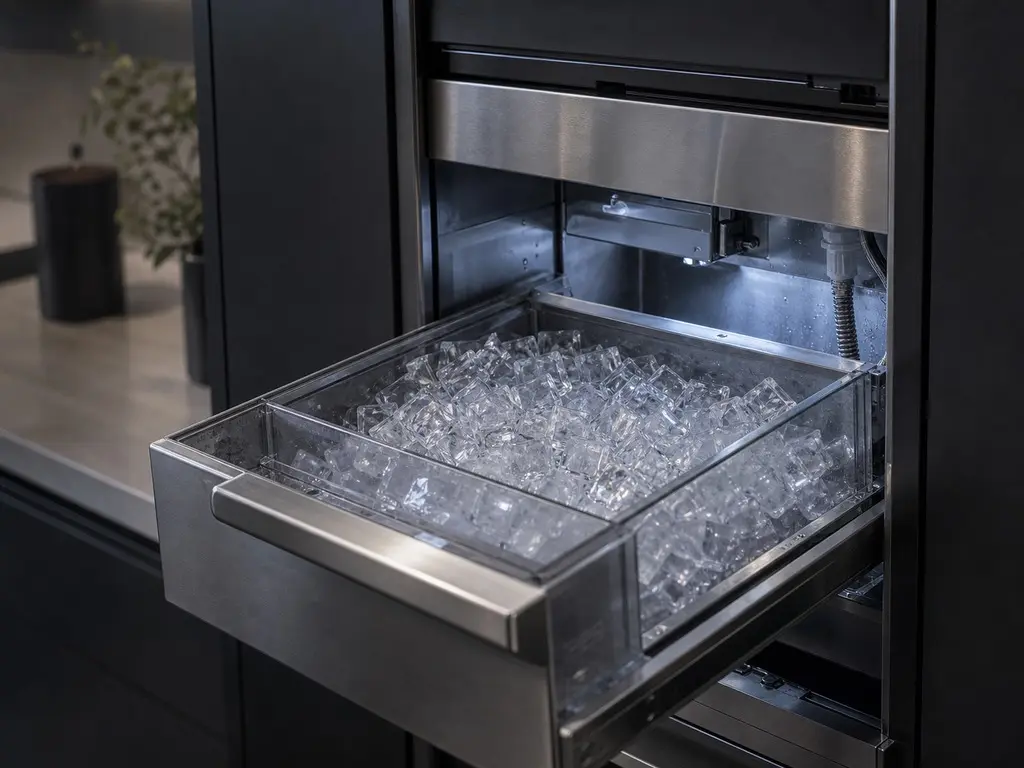
Almost nobody calls about their ice maker the day it fails. They call after months of slowly worsening signs — smaller cubes, hollow cubes, a slower fill, then a tray that finally stops cycling. In Cupertino and across the Santa Clara Valley, that slow decline usually traces back to one quiet culprit: mineral content in the water.
South Bay tap water is moderately hard, and a built-in's ice and water system is the part that drinks it all day. Understanding how that plays out helps you catch it early, before a scaled valve turns into a leak under the crisper.
How mineral scale builds in a built-in
Every ice cycle pushes a measured shot of water through a fill valve, down a fill tube and into the ice module's mold. With moderately hard water, a thin mineral film deposits on each of those surfaces over time. The fill valve's tiny metering port narrows, so each cycle delivers slightly less water — which is exactly why the cubes get smaller and hollow before they stop entirely.
The same scale stiffens the fill tube and can crust the mold's release surface, so cubes stick instead of dropping. None of it happens overnight, which is what makes it easy to ignore until the system gives up.
The signs that are worth a call
Watch for the progression, not just the failure. Shrinking or hollow cubes, a noticeably slower refill after you empty the bin, cubes that clump or smell flat, or a faint pooling of water at the base of the fridge cavity are all early flags. A small puddle under the crisper drawer is the one to treat as urgent — a scaled or weeping fill valve can drip onto the floor of a built-in cabinet, and in an integrated install that water has nowhere good to go.
What the fix involves — and how to slow the clock
Most of these jobs come down to a fill valve, a fill tube or the ice module itself, replaced with genuine OEM parts and the water line checked end to end for a clean, leak-free reconnection. We diagnose first: model and serial, a flow check, and a look at the valve and line before anything is swapped, so you are not paying to replace a healthy part.
To slow the next round of scale, keep the water filter on its schedule and have the line and valve looked at during an annual visit. On Cupertino water, that simple cadence is the difference between a long, quiet service life and a surprise leak.
